


Improving the Air Force’s Situational Awareness on the Flight Line
As the UX Design Lead on the Boeing Mission Accelerator project, I was responsible for guiding the design process from discovery through MVP launch. The product was aimed at transforming communication and task coordination for C-17 aircraft maintenance crews at Air Force bases. The problem space was complex, highly physical, and had never been tackled by Boeing in this way before.

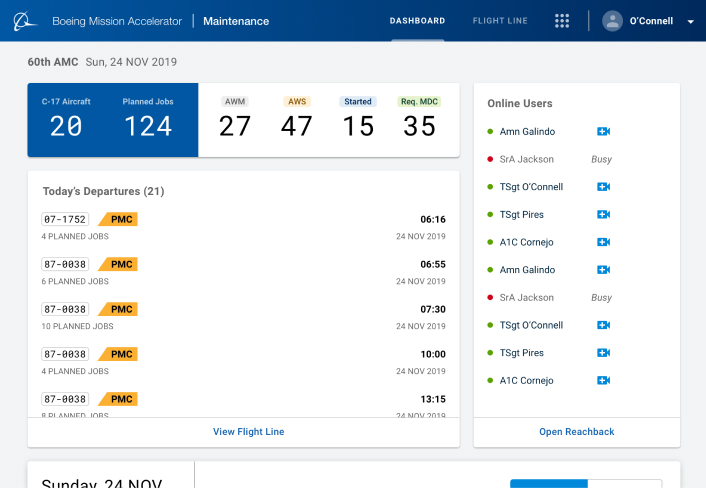
Dashboard and Adding Team Member Screens in Boeing Mission Accelerator
Challenge
How might we give Air Force maintenance squadrons real-time visibility and coordination tools to better manage flight line operations and reduce downtime for C-17 aircraft?
Background
This project was initiated after a former Air Force Colonel—now a Boeing team member—noted significant inefficiencies during his time overseeing maintenance operations. The squadron responsible for C-17 maintenance relied on a fragmented set of tools: aging government systems, whiteboards, walkie-talkies, and literal drive-bys for updates. These methods left the team with limited visibility into job status, constant communication overhead, and challenges coordinating tasks across roles. When Boeing formed a product team to tackle the issue, I was brought in as UX Design Lead to guide the research, shape the design direction, and coach the team through a lean, user-centered process.
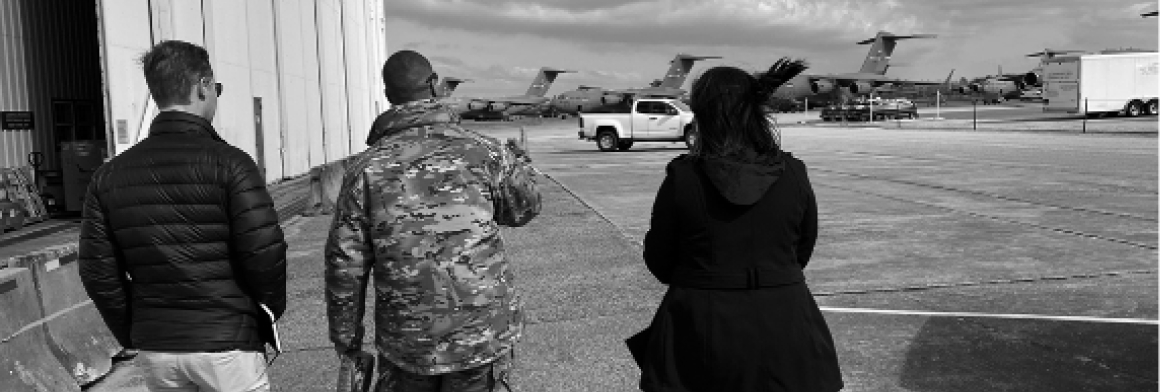
Contextual interviews with air base team members
Approach
We began with a Discovery & Framing workshop where I introduced the team to Lean UX and structured collaborative activities to define our direction. Our initial hypothesis was:
“A shared digital platform would help a C-17 maintenance squadron reduce time spent coordinating offline, increase visibility into job status, and improve decision-making across the base.”
To validate this, we interviewed and shadowed dozens of users at Travis and Charleston Air Force Bases, including maintainers, expeditors, production supervisors, and section chiefs. Their workflows were complex and high-stakes, often dependent on unreliable Wi-Fi, slow-loading legacy systems, and radio calls to track people down.
One particularly telling insight: at the end of a shift, airmen would verbally pass job updates to the next crew—if they remembered. There was no central source of truth.

Affinity mapping problems
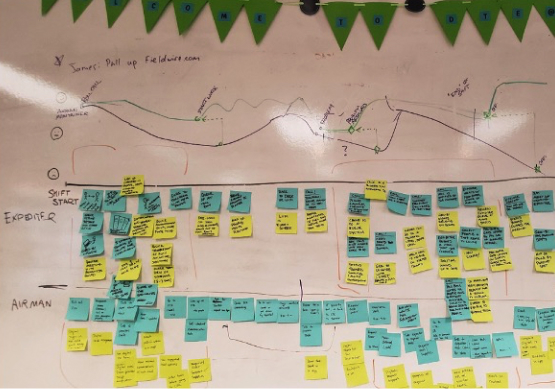
Current and future state mapping
Insights
From our fieldwork, a few major pain points emerged:
- Information was fragmented across outdated, often crashing, systems
- Situational awareness was low, requiring constant in-person or radio updates
- Job planning and assignment processes were slow and inconsistent
- Connectivity on the flight line was poor, affecting access to tools
These were not just frustrating—they were creating inefficiencies that directly impacted the squadron’s mission readiness.
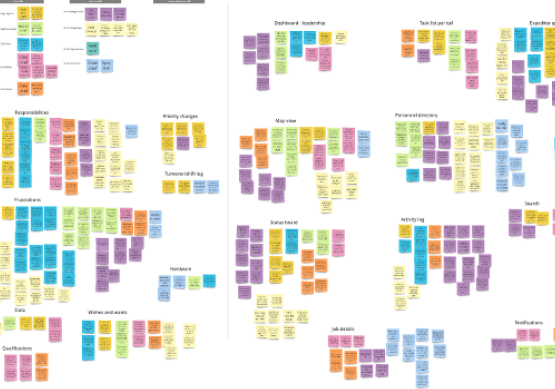
User interview insights affinity mapping

Journey mapping
Design Iteration
Initial wireframes were sketched during the Discovery workshop. We quickly moved those into clickable prototypes using Sketch and InVision. These prototypes allowed us to gather early feedback from users during on-base visits and remote walkthroughs.
The MVP focused on just a few high-impact workflows:
- Assigning airmen to jobs based on qualifications
- Viewing job statuses across aircraft
- Adding notes for shift turnover
- Reducing need for verbal updates and radio use
I also created a living style guide to establish consistency and scale future UI work, anticipating that other designers might join the team later.
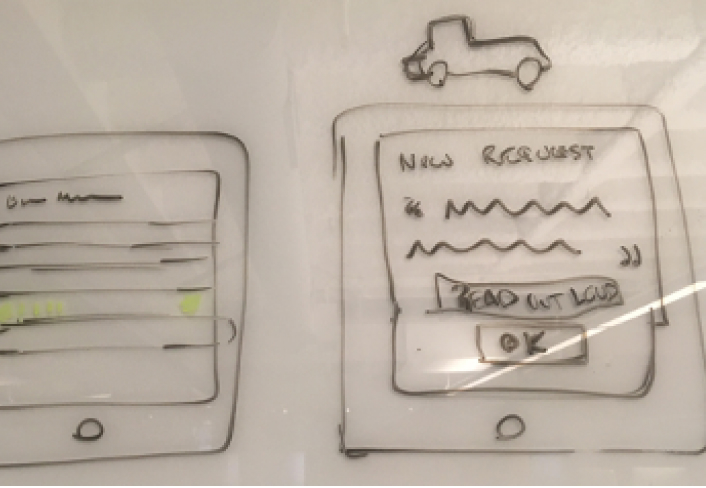
Whiteboarding ideas with the team

Low-resolution wireframes used for user feedback
High-resolution wireframes used for usability testing
Outcome
Although the original goal was a 3-month MVP launch, several delays—accessing a government database (GO-81), installing a Wi-Fi puck system, and pandemic-related base restrictions—pushed launch to October 2020.
Still, the results were strong:
- The new product had 60+ weekly active users shortly after launch, despite limited crew size
- We recieved positive feedback from maintainers and leadership around situational awareness improvements
- We built and established trust with the base, who noted our team’s responsiveness and iterative approach
- The team also adoption of Lean UX principles, even when PMs and devs were previously unfamiliar with the methodology
We also introduced a survey to gather qualitative and quantitative insights post-launch. Sample questions included:
- “Has your radio usage for job updates increased, decreased, or stayed the same?”
- “Do you feel your situational awareness has improved while using the app?”
The product is still in use today, and the team continues to explore additional capabilities—like staff training management and roadblock tracking—based on new needs uncovered during the project.

Personnel Availability and Flight Line Overview screens for F-15 program
Impact
This project was deeply rewarding. Not only did it modernize mission-critical workflows in a complex, high-security environment, it also gave maintainers tools they could rely on—even under tough constraints. It built cross-functional momentum around Lean UX practices, and demonstrated that agile, user-centered design can thrive even in traditional, structured organizations like Boeing. It also paved the way to scale to other bases and other aircraft programs like F-15.