


Launching a UX Design Program at Lewis and Clark Community College
In 2023, as a seasoned UX design leader and advisory board member at Lewis and Clark Community College (LCCC), I saw an opportunity to transform the educational landscape by launching a UX design program. Leveraging my 12 years of industry experience, I took ownership of this initiative, advocating for its creation, securing state approval, and designing its curriculum. My role encompassed researching industry needs, crafting course content, collaborating with the head of the graphic and web design department, and driving student enrollment through targeted marketing. By Fall 2024, I successfully launched two foundational UX courses, empowering students with in-demand skills and earning recognition for advancing LCCC’s mission to prepare students for thriving careers. This project fueled my passion for shaping the next generation of UX designers.

Teaching the Interaction Design course online
Challenge
How might we equip LCCC students with UX design skills to meet industry demand while ensuring an affordable, accessible education?
The St. Louis region faced a growing demand for UX and product designers, with over 90,000 U.S. job postings on LinkedIn and an average entry-level salary of $82,000 (Glassdoor, 2020). Yet, LCCC’s curriculum lacked UX-specific training, leaving students unprepared for these lucrative, impactful roles. Competing online training programs were often costly and inaccessible to LCCC’s diverse student body. Securing approval from the Illinois Community College Board (ICCB) posed a hurdle, requiring a robust case to justify resources amidst budget constraints and faculty skepticism about UX’s academic fit. My challenge was to bridge this educational gap, aligning with industry needs while making UX education inclusive and sustainable.
Background
Lewis and Clark Community College, located in Godfrey, Illinois, serves over 7,000 students, many from diverse and non-traditional backgrounds, in a region with a vibrant but underserved tech ecosystem. In 2022, LCCC’s graphic and web design programs thrived, but they lacked UX-focused training despite a 23% projected growth in UX-related jobs through 2030 (U.S. Bureau of Labor Statistics). Major employers like Boeing and Mastercard in St. Louis sought UX talent skilled in user research and design. My industry experience revealed this gap firsthand, and the rise of online UX bootcamps underscored the urgency to offer affordable, local training. ICCB standards demanded rigorous curriculum justification, pushing me to craft a program that balanced academic rigor with practical relevance.
Approach
I applied a UX-inspired design thinking process to create the program:
- Empathize: I conducted market analysis, surveyed 50 students in non-UX design classes, and held short interviews to understand their career aspirations. I also studied online UX courses and textbooks to inform curriculum structure.
- Define: I synthesized findings into a program proposal, articulating objectives like industry alignment, affordability, and skill development. Personas like “Aspiring Anna,” a career-switching student, guided my approach.
- Ideate: I collaborated with the head of the graphic and web design department to brainstorm course topics, delivery formats, and industry partnerships.
- Prototype: I drafted syllabi for two courses—Introduction to UX Design and Interaction Design—outlining project-based learning with tools like Figma.
- Test: I gathered feedback through student surveys and department reviews, iterating on course formats and assignments to enhance engagement.
- Implement: I pitched the curriculum to the ICCB, revised it based on their feedback, and secured approval. I also developed a marketing strategy with flyers, social media posts, and instructor talking points.
This iterative process ensured the program met student, industry, and regulatory needs.
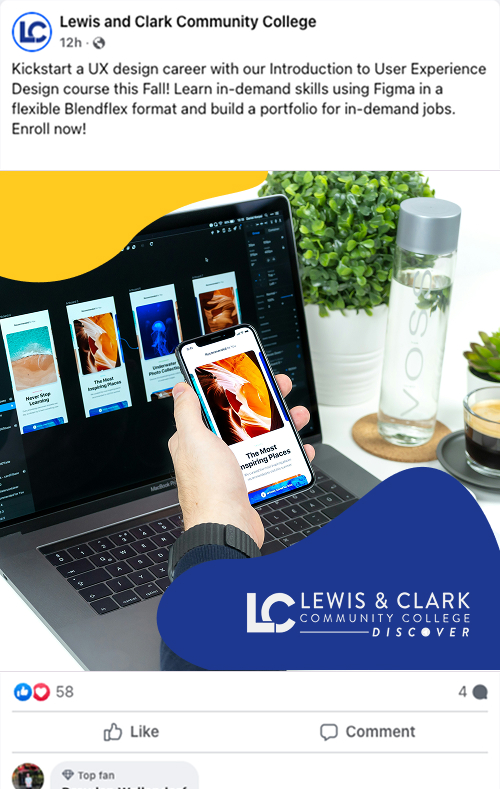
Facebook post introducing the Intro to UX Design course
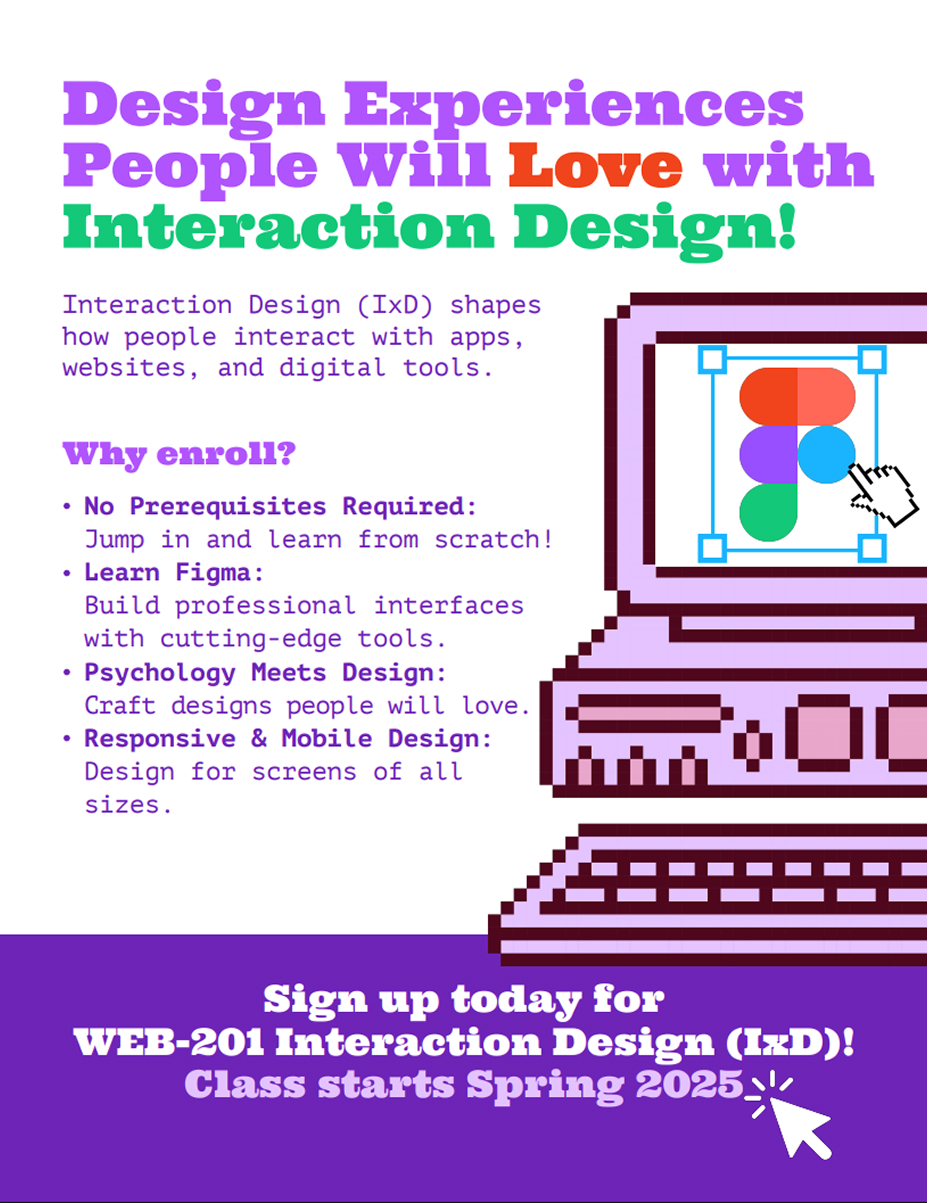
Flyers hung across campus introducing the Interaction Design course
Insights
Research revealed critical stakeholder needs:
- Student Motivations: Students were eager to learn UX skills, recognizing their value from daily interactions with apps and websites. They sought affordable, flexible training to build portfolios for high-paying jobs.
- Employer Feedback: Local firms emphasized the need for skills in user research, Figma prototyping, and usability testing. They supported seeing a UX certificate or degree in this field on the applicant’s resume.
- Faculty Perspectives: The design department was open to making UX courses degree requirements and expanding offerings, though some initially questioned resource allocation.
- Market Trends: The $20 billion acquisition of Figma by Adobe (2022) underscored its dominance, validating its use in the curriculum.
- Feedback Iterations: Student surveys highlighted a preference for hands-on projects and flexible formats, leading to a blendflex (in-person and Zoom) course structure.
These insights shaped a curriculum focused on practical, industry-relevant skills accessible to diverse learners.
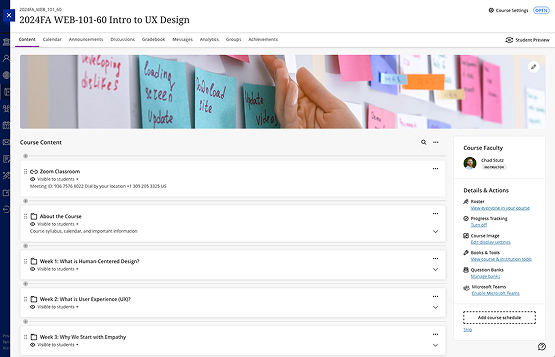
Introduction to User Experience (UX) course in Blackboard
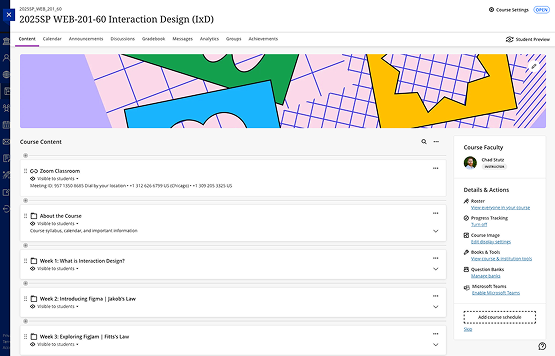
Interaction Design (IxD) course in Blackboard
Outcomes
The UX program, launched in Fall 2024, introduced two cornerstone courses with the following features:
- Curriculum Design: Introduction to UX Design covered the UX process (Empathize, Define, Ideate, Prototype, Test, Implement), human-computer interaction, and wireframing. Interaction Design focused on the five dimensions of interaction design, using Figma for responsive web/app prototypes.
- Blendflex Delivery: Courses offered in-person and online via Zoom, ensuring accessibility for working students and those with varied schedules.
- Figma Integration: Leveraged Figma’s free educational license, enabling students to master an industry-standard tool used by 4 million designers.
- ICCB Approval: Secured through a compelling pitch emphasizing job demand, salary potential, and societal impact, with iterations based on board feedback.
These features balanced academic rigor with practical, inclusive education.

Teaching the Introduction to User Experience (UX) course online
Impact
The UX program transformed LCCC’s offerings, doubling enrollment year-over-year (100% growth) since introduced, with courses now attracting students eager to learn in-demand skills. Students developed problem-solving abilities through the UX design process, creating portfolio-ready projects that showcased their expertise in research, wireframing, and prototyping.
Future plans include launching a UX certificate, adding courses in UI design, and making UX a requirement for design degrees, ensuring sustained impact. My teaching evolved to embrace asynchronous formats, with high-quality recorded lectures meeting student demand for flexibility. This journey, rooted in my passion for training the next generation of designers, empowered students to shape technology’s future while reinforcing LCCC’s commitment to accessible, transformative learning.