


Unifying the Admin Experience with Autodesk’s Connected Admin Vision
In 2024, as a Principal Product Designer supporting the admin experience at Autodesk, I led a team of cross-platform designers focused on the development of the Connected Admin Vision, a 3-year vision to unify the fragmented experiences of Core, Project, and Developer Admins across Autodesk’s disjointed platforms. I spearheaded cross-team alignment, facilitated workshops, and presented the final vision to stakeholders and leadership, rallying multiple product teams—Autodesk Account, cloud collaboration, and Autodesk Platform Services (APS)—around a shared goal. My role involved synthesizing admin pain points, defining a cohesive vision, and crafting a narrative through five user scenarios to demonstrate its impact. Launched as a guiding framework, this vision has shaped Autodesk’s strategic roadmap for 2025 and beyond, earning enthusiastic admin feedback and fostering organizational unity.

Example future-state scene from the Connected Admin Vision
Challenge
How might we unify disconnected admin experiences across Autodesk’s platforms to enhance visibility, control, and forecasting for Core, Project, and Developer Admins?
Admins, critical decision-makers with 98% influence over Autodesk purchases, faced siloed experiences across Autodesk Account, cloud collaboration tools, and Autodesk Platform Services (APS). They lacked visibility into key data, control over repetitive tasks, and tools for forecasting software needs, leading to inefficiencies and frustration. My challenge was to align diverse product teams on a holistic vision that streamlined these experiences, empowering admins to manage their environments seamlessly while supporting Autodesk’s goal of building trust and efficiency.
Background
Autodesk, a global leader in design and engineering software, relies on admins to manage user access, project workflows, and developer solutions, directly impacting organizational success. Three admin personas—Core Admins (managing licenses and compliance), Project Admins (overseeing project workflows), and Developer Admins (handling APS apps and 3rd-party solutions)—operated across disconnected platforms, from Autodesk Account to cloud tools like BIM 360. This fragmentation, exacerbated by manual processes and scattered data, hindered efficiency, particularly in mid-to-large companies with multiple admins or small firms where a single admin juggled all roles. A unified experience was critical to enhance satisfaction and drive business value.

An overview of the admin personas and how their responsibilities overlap each other
Approach
I applied a user-centered design process to craft the Connected Admin Vision:
- Empathize: Conducted interviews with 10 admins across Core, Project, and Developer roles to uncover pain points, supplemented by usage data analysis from Autodesk Account and APS.
- Define: Synthesized findings into a problem statement: “Admins are siloed, lacking visibility, control, and forecasting across their Autodesk environment.”
- Ideate: Facilitated workshops with product teams, using storytelling to brainstorm solutions like integrated dashboards and AI-driven automation, aligning on a 3-to-5-year vision.
- Prototype: Created conceptual UI mockups for five scenarios—onboarding, project setup, app management, forecasting, and offboarding—to illustrate the vision.
- Test: Shared mockups with admins in interviews, gathering feedback on features like automated onboarding and forecasting dashboards while iterating on the original story designs.
- Implement: Presented the vision to stakeholders, securing buy-in to guide strategic planning and cross-team research.
Collaboration with product teams ensured the vision bridged disparate platforms, focusing on holistic connectivity.
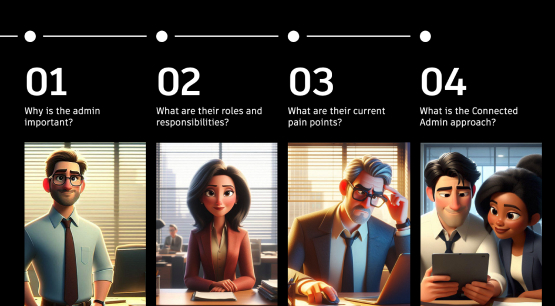
Setting context for the vision with questions about the admin experience
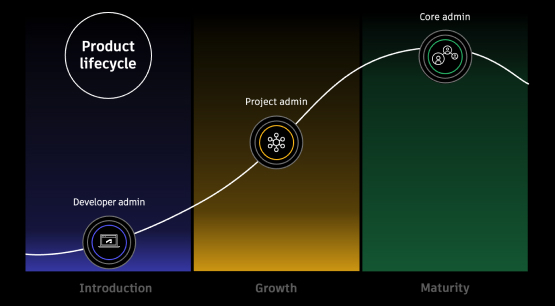
Explaining the current state of product maturity across platforms
Insights
Research revealed critical admin challenges and aspirations:
- Pain Points: Admins struggled with siloed platforms, requiring navigation across multiple portals (e.g., “too many different portals to manage everything”). Manual tasks, like onboarding, were time-intensive, and forecasting was a “complex jigsaw puzzle” due to scattered data.
- Admin Needs: Interviews with admins confirmed the importance of the vision. Core Admins needed automated user management tied to HR systems. Project Admins sought streamlined project setups, while Developer Admins wanted better app usage insights.
- Feedback: Admins praised automation (e.g., “a huge time saver”) and AI-driven forecasting (“would be fantastic”), but requested clearer role-based permissions and universal user views.
- Team Dynamics: Product teams initially operated in silos, but workshops revealed shared goals, fostering alignment on a unified experience.
These insights shaped a vision prioritizing integration, automation, and data-driven decision-making.
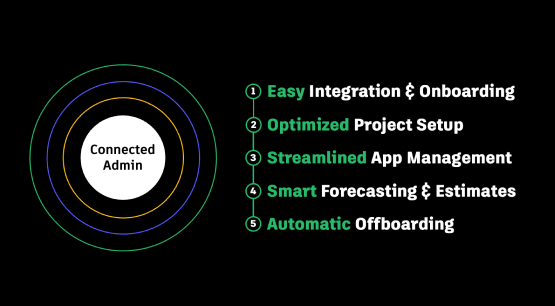
Overview of the 5 scenarios the vision will cover
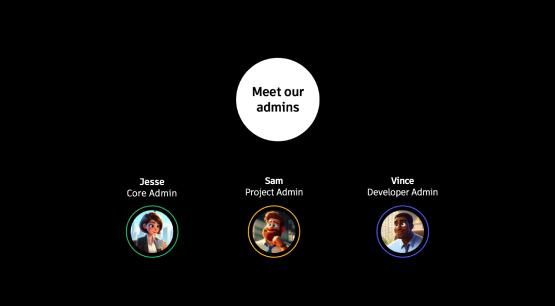
Introducing the main characters of the vision
Vision Overview
The Connected Admin Vision, launched in 2024, outlined a transformative roadmap:
- Automated Onboarding/Offboarding: Linked with HR systems like Workday, enabling admins to automatically add/remove users with role-based recommendations, saving hours per task.
- Optimized Project Setup: Allowed Sam, the project admin, to assign licenses and add project members seamlessly, with real-time license availability checks.
- Streamlined App Management: Enabled Vince, the developer admin, to track APS app usage via a dynamic dashboard, boosting project efficiency.
- Smart AI-Driven Forecasting: Provided Jesse, the core admin, with a forecasting dashboard using usage data and AI to generate accurate budget projections, simplifying leadership approvals.
- Automatic Offboarding: Offboarding users is now just as easy as onboarding where they are automatically removed and liceses are unassigned whenever the user is removed from the HR system.
These features, illustrated through scenarios set in 2028, demonstrated a seamless, connected admin experience.
Example Scenario from the Vision
With the 5 scenarios from the vision, each uses a story arc to tell the story of that persona(s). The scene starts with introducing the goals of the admin but then shifts to introduce the pain points of our current state experience. The vision then clearly articulates the resolution to those past pains and explains the overall value the characters recieve from this experience.

Part 1: Introducing the persona, goals, and past frustrations
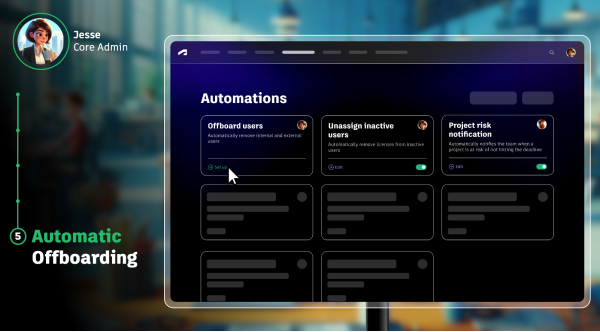
Part 2: Demonstrating how the persona interacts with the experience

Part 3: Explaining the value each persona receives from the new experience
Impact
The Connected Admin Vision unified Autodesk’s product teams, aligning them on a shared vision and strategy that transforms the admin experience. Admin feedback was overwhelmingly positive, with quotes like “Automated onboarding would be a huge time saver” and “AI forecasting would be fantastic,” validating the vision’s potential. By 2025, it had guided strategic planning, prioritizing cross-organizational projects and feature development for Autodesk Account, connected cloud products, and APS. My leadership in fostering cross-team collaboration set a precedent for holistic UX strategies, earning stakeholder praise and positioning admins to thrive in managing complex environments. Future steps include prioritizing the next phase of capabilities to bring this vision closer to reality.